REVIEW · NAIROBI
Nairobi Walking Tour: Downtown & City Tour
Book on GetYourGuide →Operated by Safari Ride Expeditions · Bookable on GetYourGuide
Nairobi downtown clicks into place on foot. This guided route strings together Jevanjee Gardens, City Market energy, major downtown landmarks, and a final skyline look from the KICC rooftop. I love starting at Jevanjee Gardens, where the city noise drops for a minute, and I love how the route ends at the KICC rooftop viewing deck for a clear Nairobi snapshot.
One possible drawback to plan for: the KICC rooftop has an extra $5 entrance fee, and food and drinks aren’t included in the tour price. The trade-off is that you get a tight, guided overview of the city’s central pulse without wasting time figuring out where to go next.
Along the way, guides like David and Lenny focus on safety and practical storytelling, including quick safety briefings and help crossing busy roads. You’ll also get useful extras like bottled water and portable Wi‑Fi, which makes it easier to navigate and pull up context on the spot.
In This Review
- Key things to look forward to on this Nairobi walking tour
- Jevanjee Gardens: the calm start that helps the rest make sense
- City Market: handicrafts, market life, and a street-food lesson you can taste
- McMillan Memorial Library and Kenyatta Avenue: seeing downtown as a connected story
- Nairobi National Archives: the place that turns scenes into meaning
- Kimathi Statue, Parliament Road, and August 7th Memorial Park significance
- KICC rooftop viewing deck: your skyline reward at the end
- Price and value: what $20 gets you (and what it doesn’t)
- Safety, road-crossing, and pace in busy central Nairobi
- What to bring, what to skip, and who should avoid this
- Who this Nairobi walking tour fits best
- Should you book this Nairobi Downtown & City Tour?
- FAQ
- How long is the Nairobi Downtown & City Tour?
- Where does the tour start?
- What is included in the $20 price?
- Is the KICC rooftop viewing deck included?
- What landmarks will I see?
- What languages are the guides?
- Do I need to bring anything for the tour?
- Is there any guidance on safety and rules?
- Can I get a full refund if plans change?
Key things to look forward to on this Nairobi walking tour

- Jevanjee Gardens start: a calm green pocket before the city chaos resumes
- KICC rooftop skyline finish: Nairobi views in a single, organized payoff
- City Market stop with food tasting: a hands-on look at everyday street food culture
- Nairobi National Archives visit: photos and documents that connect the dots for Kenya’s story
- Downtown landmarks along Kenyatta Avenue: a walk that makes the city layout make sense
- August 7th Memorial Park context: learn why this date and place matter
Jevanjee Gardens: the calm start that helps the rest make sense

The tour begins at Jevanjee Gardens, and that matters more than it sounds. Starting in a leafy area helps you switch from arriving-mode into walking-mode. You get a short introduction and safety briefing right away, which sets the tone for the rest of the route.
From there, you’re walking into downtown at city speed. That contrast is the point. Nairobi can feel loud and crowded, and this first stop gives you a buffer while your guide explains what you’re about to see and how to move through it.
If you’re a first-timer, I’d call this a smart way to get your bearings fast. You’re not just collecting sights; you’re learning the logic of the streets around them.
You can also read our reviews of more walking tours in Nairobi



City Market: handicrafts, market life, and a street-food lesson you can taste

Next up is City Market, where Nairobi feels hands-on. You’ll see stalls, produce, and everyday goods, and your guide brings the place to life with local context as you walk through. This is a great stop if you want to understand how people actually spend money, time, and conversations in the city center.
One highlight here is the combination of market time plus a cooking-focused experience: there’s a cooking class and food tasting during the market block. Even if your Swahili is limited, you’ll get a bit of language practice as part of the experience, which makes the food stop feel more like an interaction than a snack break.
Practical note: food and drinks are not included in the tour price. That means you should budget a little extra for anything you want beyond the tasting portion. Still, the tour structure makes this stop easier than trying to navigate a big market on your own.
McMillan Memorial Library and Kenyatta Avenue: seeing downtown as a connected story
After the market, the walk keeps moving along central Nairobi landmarks. You’ll pass by the McMillan Memorial Library for a quick guided look, and then you spend time on Kenyatta Avenue, one of the big-picture “how the city was built” corridors.
This part of the tour is about orientation. Kenyatta Avenue isn’t only a road with buildings; it’s where the city’s modern identity and older civic presence line up. A guide turns that lineup into something you can actually remember, instead of a blur of facades.
The pacing stays brisk but not rushed. One nice thing I’ve picked up from how guides run this walk is that they keep stopping points practical: short explanations, quick photo moments, and the kind of “here’s what to notice” guidance that turns a straight walk into a real tour.
Nairobi National Archives: the place that turns scenes into meaning
The Kenya National Archives stop changes the tone of the walk. City downtown can feel like motion and noise, but the archives bring you back to documents and artifacts that explain how the present grew out of the past. You get a guided visit plus time for photos.
This is the part that helps you connect why certain dates, movements, and memorials show up along the walk later. If you like context—maps in your head more than only photos—this stop is a strong payoff.
Also, the break in the middle of a walking tour is underrated. You’re not constantly on the move, so your brain can absorb what you just learned from the city streets.
Kimathi Statue, Parliament Road, and August 7th Memorial Park significance

The route includes a stop at the Kimathi Statue and then moves toward Parliament Road. These are short stops, but they matter because they anchor the walk in national identity rather than only in architecture.
You’ll also learn about the significance of August 7th Memorial Park. Even when you’re not spending a long time standing there, the explanation helps you understand what the place represents in Nairobi’s memory and civic landscape.
For me, this is where the tour earns its “downtown and city tour” label. It’s not only about getting photos. It’s about giving you a framework for what you’re seeing and why people care about it.
You can also read our reviews of more city tours in Nairobi




KICC rooftop viewing deck: your skyline reward at the end

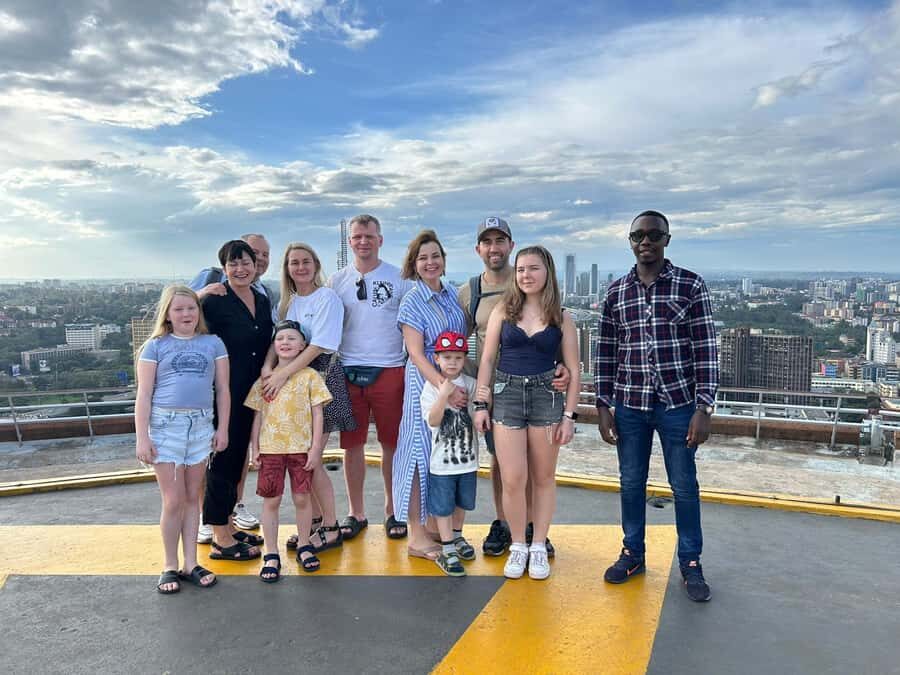
The big finish is KICC—specifically the rooftop viewing deck. The rooftop stop is what you remember after the walking is done: Nairobi spread out below you, and a clear view that makes the earlier stops feel located and real.
There’s a $5 entrance fee for the rooftop, so treat it as the one obvious add-on. The good news is that the tour includes skip-the-ticket-line, which saves time when the building and entry process can be slow.
If you’re traveling solo or you just want one “big view” moment without arranging anything complicated, this is a strong end point. It works especially well after a walking morning because your photos come with context, not just angles.
Price and value: what $20 gets you (and what it doesn’t)

At $20 per person for about 3 hours, you’re paying mainly for the guide’s route-planning, the time on foot, and the guided interpretation that turns landmarks into meaning. You also get bottled water, a portable Wi‑Fi option, and optional pickup/drop-off.
What you should plan for is separate costs:
- $5 entrance fee for the KICC rooftop
- Food and drinks beyond what’s part of the tasting
- Personal expenses
That makes this tour one of those good value formats where the base price is fair, and the “extras” are straightforward. If you already know you want the rooftop view and a snack or two, budgeting a little extra makes the whole thing feel smooth rather than surprise-y.
In practical terms, you’re buying convenience and direction. In a city like Nairobi, that can be worth as much as any ticket price.
Safety, road-crossing, and pace in busy central Nairobi

Safety is one of the most praised parts of this experience. More than one guide—like David and Michael—has been described as making people feel at ease. That fits the structure too: there’s a safety briefing early on, and you’re never fully left to figure things out alone.
The walking area involves real street activity, so road crossings matter. One small detail I really appreciate from the way guides run this tour is that they help you cross roads. In Nairobi, that can be the difference between stress and a doable walk.
The tour also builds in short pauses and photo stops. A common theme from guest feedback is that the pacing feels manageable for first-timers, including time to take photos and step aside when needed.
One last note: this is a walking experience. Wear comfortable shoes and bring enough patience for city traffic rhythms, even if you’re not in vehicles.
What to bring, what to skip, and who should avoid this

You’ll want to bring your passport or ID card. A copy is accepted. Also, there are clear rules on what’s not allowed: no jewelry, and no alcohol or drugs.
There’s also a simple suitability note: it’s not suitable for people over 95 years. If that applies, you may want a different format that reduces time spent on foot.
If you’re thinking about what to pack, the basics win: comfortable walking shoes, sun protection, and a charged phone for the portable Wi‑Fi and photo backup.
Who this Nairobi walking tour fits best
This is a good match if you:
- Want a first-time downtown introduction without building your own route
- Like history explained in plain terms, not museum-style lectures
- Want one strong view payoff at the end (KICC rooftop)
- Are comfortable walking about 3 hours with short stops
It’s especially appealing for solo travelers because the guide does the heavy lifting: safety briefings, pacing, and route flow. If you’re new to Africa or new to big-city chaos, this structure can make Nairobi feel less intimidating.
If you hate walking tours and prefer slow museum time, you might find this too fast. But if you’re here for orientation and practical city understanding, it’s a smart use of half a day.
Should you book this Nairobi Downtown & City Tour?
Book it if you want a guided, efficient way to connect Nairobi’s central sights with real meaning. I like that the tour gives you both street-level experience (City Market) and “why this matters” stops (archives, memorial context), then pays it off with skyline views at KICC.
Skip or switch if you’re sensitive to walking in busy central streets or you don’t want extra costs for the rooftop view. Also, if food is your main focus, remember food and drinks aren’t included, so you’ll be choosing what to buy on the go.
If you want a clean, guided overview that helps Nairobi feel understandable by the time you leave, this one earns its spot.
FAQ
How long is the Nairobi Downtown & City Tour?
The tour runs for about 3 hours.
Where does the tour start?
It starts at Jevanjee Gardens. Your guide will contact you to confirm your preferred meeting time and a nearby meeting area.
What is included in the $20 price?
Included items are an experienced live tour guide, bottled water, portable Wi‑Fi, and optional pickup and drop-off.
Is the KICC rooftop viewing deck included?
No. The entrance fee to the KICC rooftop is $5, and food and drinks are not included.
What landmarks will I see?
You’ll visit and walk through key central locations such as Jevanjee Gardens, City Market, McMillan Memorial Library, Kenyatta Avenue, the Kimathi Statue, the Kenya National Archives, and KICC.
What languages are the guides?
The tour is offered with live guidance in English and Swahili.
Do I need to bring anything for the tour?
You should bring your passport or ID card. A copy is accepted.
Is there any guidance on safety and rules?
Yes. There is a safety briefing at the start. Jewelry is not allowed, and alcohol and drugs are not allowed.
Can I get a full refund if plans change?
Free cancellation is available up to 24 hours in advance for a full refund.