REVIEW · NAIROBI
Nairobi City Tour
Book on Viator →Operated by Kensil Tours and Travel · Bookable on Viator
Two towers and a train museum in one go. This Nairobi City Tour is built for quick orientation, stacking major sights in about 3 hours so you can understand how Nairobi works on the ground and from above.
I like the way it delivers two very different Nairobi angles: a rooftop sweep from KICC plus hands-on history at the Nairobi Railway Museum. Second, I really appreciate that you’re not stuck figuring logistics alone—there’s pickup and a professional driver/guide keeping the day smooth.
One consideration: the core tour price doesn’t cover KICC or the Railway Museum entry fees, so your final cost will be a little higher once tickets are added. Also, it’s a group format (max 30), so you’ll be moving at a tour pace rather than lingering forever.
In This Review
- Key highlights you’ll actually care about
- Why this 3-hour Nairobi city tour is great for your first day
- KICC rooftop climb: the fastest way to understand Nairobi geography
- Nairobi Railway Museum and the Tsavo lions connection
- August 7th Memorial Park: history you can’t skip
- Downtown walk time: city bus spotting and market energy
- Price and value: what $50 really covers
- Pick-up, pacing, and comfort tips for a smooth day
- Who should book this Nairobi City Tour?
- Should you book it?
- FAQ
- How long is the Nairobi City Tour?
- What does the tour price include?
- Which places require extra admission fees?
- Is August 7th Memorial Park admission included?
- What are the main stops on the tour?
- Is pickup offered?
- How big is the group?
- Can I cancel and get a full refund?
Key highlights you’ll actually care about

- KICC rooftop views: See downtown, up town, and Eastland from above
- Railway Museum storytelling: Track rail changes through Kenya’s timeline, including the Tsavo lions episode
- August 7th Memorial Park included: Museum entry + a video walkthrough of what happened in 1998
- Downtown walking focus: Watch everyday routines, including a city bus passing through
- Market time: You may get a stop that feels like a Maasai market setup—bring cash and expect bargaining
- Small-group feel: Maximum of 30 keeps it manageable for first-time visitors
Why this 3-hour Nairobi city tour is great for your first day
Nairobi is one of those cities where you can easily feel lost if you only see it at ground level. This tour helps you get your bearings fast, mixing big landmarks with daily-life scenes. In a short window, you’ll go from skyline views to rail history to a memorial that gives the city’s modern story real weight.
The format is simple and practical: you start with a high point, move into museums, then finish with a guided city walk. That order matters. Views help you connect what you later see on the streets to real neighborhoods, and museums give context before your brain files everything away as random stops.
If you want an intro tour that doesn’t feel like a checklist recital, this fits. It’s also a good choice if you’re short on time but still want variety: architecture, transport history, national tragedy, and street-level city life.
You can also read our reviews of more city tours in Nairobi

KICC rooftop climb: the fastest way to understand Nairobi geography

The Kenyatta International Conference Center (KICC) is your first big payoff. You get time at the site to climb up to the top, then enjoy a panoramic look across Nairobi. This is where the city stops feeling abstract and starts looking mapped.
What I like here is the clarity of the view. You’re able to see down town, up town, and Eastland from one vantage point. Even if you’re not memorizing neighborhood names, you’ll recognize the different “directions” of the city—helpful for later when you’re spotting where things are relative to where you’re staying.
Two practical notes:
- Plan on stairs and time up there. It’s not a long stop, but the climb and viewpoint experience do take energy.
- Entry isn’t included. The tour covers the experience day and guiding, but KICC tickets are your responsibility.
You’ll also hear background on the building and the architect connected to its construction. The key value is not just the name—it’s learning how Nairobi’s identity shows up in major structures, especially in a landmark like this.
Nairobi Railway Museum and the Tsavo lions connection
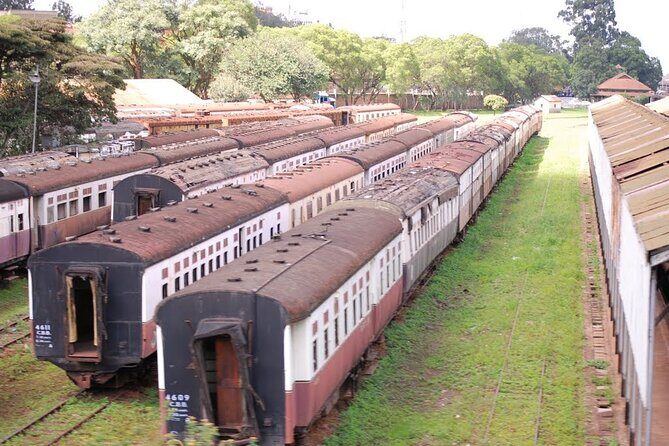
Next is the Nairobi Railway Museum, a spot that turns what you usually think of as background into a real story. The museum focuses on how rail transport evolved over time—covering changes from before Kenya gained independence through to later developments.
This stop works because it ties local history to something people remember from popular accounts: the man-eating lions of Tsavo. In the museum setting, you learn how that event acted as a serious obstacle during construction of certain railway lines. It’s one of those connections that makes the history feel less like dates on a wall and more like human problems, decisions, and risk.
What to expect in your hour:
- A guided visit inside the museum spaces
- Explanation of how rail lines and transport shaped movement and development
- The Tsavo lion story presented as part of the rail construction narrative
Like KICC, Railway Museum entry fees aren’t included in the base price. Still, if you like transport history, engineering stories, or you just want something different from standard city sightseeing, this museum is a strong middle stop.
August 7th Memorial Park: history you can’t skip
By the time you reach August 7th Memorial Park, the tour shifts tone. The museum history traces back to 1998, when the American embassy in Nairobi was attacked. This stop includes time to preserve and explain what happened, with a video shown about the day’s events and how the attack was carried out.
I appreciate how this stop is handled in the itinerary: it’s not rushed through as a quick photo spot. You get about an hour, which is enough time to watch the video and absorb the context without feeling like you’re just passing by.
Entry to the August 7th Memorial Museum is included, which is great value. It means you’re not scrambling to add costs mid-day, and it keeps the tour’s pacing coherent.
One consideration: this is serious content. If you’re traveling with anyone who prefers lighter sightseeing, you can still attend, but set expectations. It’s historically important, emotionally heavy, and worth giving the time it deserves.
Downtown walk time: city bus spotting and market energy
After museums, the tour moves back to everyday Nairobi. You’ll get a guided walk where you learn the flow of day-to-day activities—where people go, how they manage their routines, and how the city feels when you’re at street level instead of above it.
You’ll also watch a city bus drive through the city, which gives you a quick sense of transport habits and what public life looks like in motion. And there’s market time built into the experience—about 30 minutes in total for this final segment.
You might run into market-style shopping areas that feel like a Maasai market setup. If that happens, here’s the practical advice: bring some cash for small purchases and treat bargaining as part of the experience. If you’re uncomfortable negotiating, you can still browse, but keep it gentle and don’t feel pressured to buy.
The city-walk piece is also where the tour earns its name. This is when you understand Nairobi isn’t only monuments—it’s people working, moving, trading, and living.






Price and value: what $50 really covers
The listed price is $50 per person, and the tour runs about 3 hours. That price covers a lot of the “day you don’t want to plan” work: transport, a professional driver and guide, and entry to the August 7th Memorial Museum.
Not included: KICC and Nairobi Railway Museum entry fees. So your real total cost is the tour price plus tickets for those two sites.
Here’s how I’d judge the value:
- If you’d otherwise pay for transport and pay separate guides (or struggle to coordinate multiple stops), the $50 makes sense because it bundles time and navigation.
- If you’re already planning to visit KICC and the Railway Museum anyway, the tour price becomes even more efficient because you’re paying for guided transitions, timing, and context.
- If you’re only interested in one or two stops, it might feel like extra. But with four stops across different themes, the day generally justifies itself for first-timers.
Group size is max 30, and group discounts are available. If you’re traveling with friends, it can reduce cost further and keep the group manageable.
You can also get mobile tickets, which is helpful when you’re bouncing between sites and don’t want to juggle paper.
Pick-up, pacing, and comfort tips for a smooth day
Pickup is offered, which matters in Nairobi because travel time can eat your schedule. Starting with transport means you spend more of your limited hours seeing things and less time hunting for directions.
The pacing is structured:
- Short stop for KICC (about 30 minutes)
- Museum time at Railway Museum (about 1 hour)
- Memorial Park (about 1 hour)
- Final walk and market time (about 30 minutes)
That schedule is tight enough to be efficient but not so frantic that you can’t understand what you’re seeing. Still, if you’re the type who likes to linger, remember you’re on a group timeline.
Comfort tips that make a difference:
- Wear shoes you can walk in for markets and city sidewalks.
- Bring cash for any ticket add-ons and market shopping.
- Have a light layer if you feel temperature swings during the day.
- If you’re interested in photos, keep your hands ready—some viewpoints and museum moments are timed to the group’s movement.
If you want a guide recommendation based on real experience, Kelvin is a name that comes up for this tour type, described as friendly and ready to answer questions. A guide like that is worth its weight when you’re trying to understand Nairobi fast.
Who should book this Nairobi City Tour?
This is a smart fit for:
- First-time visitors who want an intro to Nairobi without spending an entire day
- Travelers who like history but also want street-level context
- People who appreciate a mix of architecture, museums, and daily life
- Short-schedule travelers who still want more meaning than just photos
It’s less ideal if you want a slow, flexible private tour with lots of downtime. This is structured and guided, and the timing moves you along from stop to stop.
If you’re traveling with family, it can work because the main stops are clear and time-bound. Just note the serious emotional content at August 7th Memorial Park.
Should you book it?
I’d book this Nairobi City Tour if you want a fast, well-organized way to understand the city across multiple angles—skyline views at KICC, a rail history story at the Railway Museum, and the heavier context of August 7th Memorial Park, then finishing with a downtown walk.
Choose another option only if you’re primarily interested in one single stop (like just KICC) or if you need a long, unhurried experience. Here, the value is in the combo.
If your goal is orientation plus real context in a half-day, this tour does that job.
FAQ
How long is the Nairobi City Tour?
It’s about 3 hours total.
What does the tour price include?
The tour includes transport and a professional driver and guide, plus entry to the August 7th Memorial Museum.
Which places require extra admission fees?
KICC and the Nairobi Railway Museum entry fees are not included in the tour price.
Is August 7th Memorial Park admission included?
Yes. Entry fee August 7th Memorial Museum is included.
What are the main stops on the tour?
You’ll visit KICC, the Nairobi Railway Museum, August 7th Memorial Park, and then take a guided city walk that includes markets.
Is pickup offered?
Yes, pickup is offered.
How big is the group?
The tour has a maximum of 30 travelers.
Can I cancel and get a full refund?
Yes. You can cancel up to 24 hours in advance for a full refund. If you cancel less than 24 hours before the start time, the amount you paid won’t be refunded.